
The celeriac starter hiding among the Paris bouillon classics
A tangle of pale celeriac in dressing makes a surprisingly useful first course when you are choosing what comes after it.
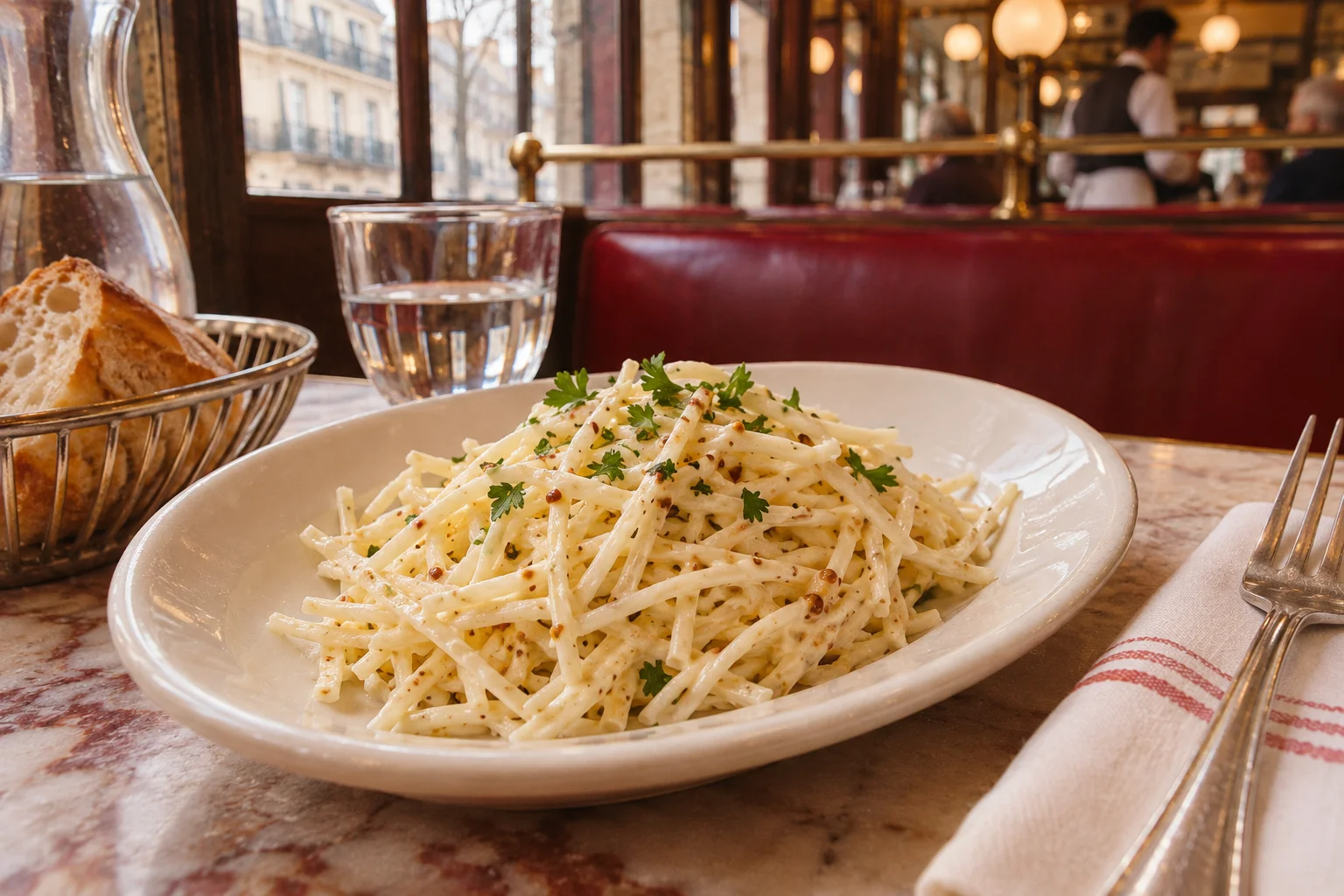
Recognise the vegetable under the dressing
Celeriac is the knobbly root you may have seen at a greengrocer beside the carrots and turnips. Trimmed and cut into slender pieces, it looks very different from the vegetable you might roast at home. In a dressed starter, what matters first is its gentle celery-like flavour and the way the cut pieces keep their texture in a creamy coating.
Bouillon Chartier's English sample menu includes celeriac in a mayonnaise dressing. The venue makes clear that its actual menu changes. Treat the listing as a way to recognise a dish when you see it on the day's card. If you have come for this particular starter, find it on the menu for the dining room you are visiting before deciding the rest of your lunch.
A reader who has heard the French name céleri rémoulade may expect one familiar formula. In practice, the useful question at the table is how the restaurant has dressed the celeriac today. Ask if you would like to know how mustardy or sharp the preparation is. Celeriac can carry a lively dressing while still tasting recognisably of the vegetable.
A starter chosen for its texture
Compare this dish with two other starters on the sample menu. A hard-boiled egg in mayonnaise gives you a soft, rich centre against the dressing. Celeriac brings a little resistance to every bite. Leeks with dressing present yet another texture, softer and more yielding than the cut root. Someone who usually chooses “the vegetable starter” can end up with very different first courses depending on which line they order.
If you want to notice that difference, take a forkful of the celeriac on its own before reaching for bread. Then lift another small forkful onto a torn piece of baguette if bread is available. Bread takes up a little of the dressing and softens its intensity. The same starter can feel brisk and vegetal on the fork and almost sandwich-like when eaten with its bread.
When the plate has both well-coated pieces and a little dressing left on the side, draw only part of the celeriac through that extra dressing. Taste it alongside the less heavily dressed pieces. A fairly small serving can reveal a surprisingly clear preference for one balance or the other. Remember that balance if you later order a similar dish elsewhere.

Pair it with what you really want for lunch
Read the main courses before committing to the starter. If you are planning a substantial main in sauce, a lightly eaten serving of celeriac can give you a fresh-tasting beginning. If the celeriac on offer looks richly dressed and you already want a creamy main and a creamy dessert, think about whether a different first course would give your meal more variety.
A pair of diners who both want to taste traditional starters could order celeriac and an egg dish, if both appear that day. Ask whether the table can share them and whether you can have a small spare plate. Each person then gets a meaningful portion of the vegetable rather than a token shred transferred from one fork to another.
There is also a perfectly good case for ordering the celeriac while your companion skips a starter. Decide together how you want the courses to arrive and tell the server when you order. Someone who intends to eat slowly and someone trying to fit lunch into an hour can both enjoy the same dining room, but a half-understood plan will make the timing feel less comfortable.
Read the dressing when ingredients matter
The clearest description on the English menu is the mention of mayonnaise. If egg or mustard matters to your order, ask about the actual preparation and any relevant kitchen procedures. Avoid relying on the idea that a vegetable dish will automatically suit every diner. Equally, do not expect the word rémoulade on two different menus to tell you everything about either kitchen's ingredients.
For travellers practising a little French, point to the name on the menu and ask about one ingredient at a time. Showing staff the line you mean makes it easier to distinguish the celeriac starter from another dish served with mayonnaise. If you are using a translation app, type a short specific question about the food rather than the name of an entire diet or a long account of your itinerary.
A person who simply dislikes a strong mustard flavour can ask a question about taste. A person who needs ingredient information should say so directly. Those are different questions for a kitchen to answer. Sorting them out before ordering is kinder to both the diner and the staff than returning a dressed dish that cannot easily be separated into its original parts.
Bring the idea back to your own table
Pay attention to the cut. Long fine shreds catch a little dressing across a large surface. Thicker pieces ask more of the teeth and tend to carry less dressing per mouthful. If this is the starter you remember after a Paris lunch, the thickness of the pieces may be as important to recreating it as the precise seasoning. Take a short note after the plate is cleared.
Also consider the serving size. As a first course, the dish only needs enough of the crisp root and rich coating to make you ready for what comes next. At home, start with the amount you would want immediately before another plate. Someone making celeriac the main part of a sandwich or picnic will want a different proportion of bread and dressing.
Finally, a starter is a good place in a bouillon meal to try an unfamiliar vegetable. You can choose a main you already know and find out whether celeriac is a dish you would order a second time. The sample menu gets you as far as the right line on the card. The actual pleasure is discovering whether you like that cool crunch enough to seek it out on your next lunch in Paris.
If you are writing the order down for someone who will join you later, include the fact that it is a starter and specify the dressing. Celeriac alone could just as easily suggest a hot mash alongside a main course. Describing the cool cut root and its coating gives your companion a fair idea of both texture and portion before they take a seat.
Build a small tasting from the first courses
Consider two friends who have never eaten in a bouillon and want to use the starters to get their bearings. If the current menu includes them, celeriac and herring with steamed potatoes make a revealing pair. The root gives a fine, cool crunch in a creamy dressing. Fish and potato offer a stronger savoury taste against a soft base. Share a little from each plate before choosing a favourite. The contrast makes both dishes easier to appreciate.
A table of three might add the hard-boiled egg with mayonnaise. Here the celeriac and the egg have a dressing in common, while their textures are far apart. Give each person a forkful of the vegetable plate and a little of the egg. Try the celeriac after the egg, then take a sip of water before returning to the fish. A few carefully chosen bites will tell you more about the menu than each person ordering exactly the same starter.
There is a limit to how much sharing makes sense. If the celeriac is the dish you specifically came to try, order a plate of your own. It is difficult to decide whether you actually like a dish when your whole experience consists of three shreds passed across a crowded table. In that case a second diner ordering something else still gives the two of you a useful comparison when you talk about lunch later.
Buy a celeriac with one dish in mind
If the starter leaves you thinking about making it at home, buy a root that fits the number of portions you want. Celeriac has a rough exterior with crevices and needs trimming. The usable part is smaller than the whole thing looks at the shop. Someone cooking for one can ask a greengrocer whether a smaller root or a section is available. A suitable size makes trying the dish easier than buying a huge vegetable and finding a new use for it every day of the week.
Before shopping for a dressing, decide whether it was the celeriac's flavour or its fine cut that made the dish special to you. Try cutting one small section into narrow matchsticks and another into a slightly coarser shape. Dress a little of each and taste them side by side before cutting the remaining vegetable. If your favourite part of the Paris plate was its lively crunch, this simple comparison can be more informative than buying an elaborate set of condiments.
Plan what will sit beside it. With a substantial main, the celeriac can remain a small, bright opening. For a cold lunch, a bigger portion alongside bread, a boiled egg or fish has a different job. Use a serving plate that lets you keep the components separate until each diner puts a forkful together. One person may like the root and egg in the same bite, while another wants a clean contrast between the two.
Bring the experiment back to your next bouillon menu. When you know whether you liked the root itself, the cut, the dressing or the company of another starter, an unfamiliar first course becomes easier to choose. You have a precise preference to take to the next dining room, which is a better reward from lunch than simply recognising one more French dish by name.